
Serving Anoka, Hennepin, Ramsey, Washington, Scott, Dakota & Carver Counties
Speech Delay vs Autism: What Every Twin Cities Parent Needs to Know

Quick Answer
A speech delay vs autism comparison almost always comes down to one distinction. Speech delay affects one skill: talking. Autism affects how a child connects, communicates, and relates to others, and speech is only one part of that. A child can be a late talker with no autism traits at all, or can speak on schedule and still show autism traits in how they use language socially. The sections below walk through the specific behaviors a clinician actually looks for.
Table of Contents
What Are the Signs of a Speech Delay?
A child with a pure speech or language delay wants to communicate just as much as any other toddler. They simply don’t have the words or sounds yet to do it.
In our clinic, this is the profile we see most often when a family comes in worried about a late talker. The child points at the fridge, drags a parent by the hand to the toy shelf, makes eye contact, laughs at the right moments in a game of peekaboo, and gets visibly frustrated when they can’t make themselves understood.
The specific signs of a speech delay we look for:
- Strong nonverbal communication. Pointing, waving, showing you objects, pulling you toward something they want.
- Good receptive language. They understand far more than they say, following two-step directions (“get your shoes and put them by the door”) even with few spoken words themselves.
- Typical social back-and-forth. Joint attention is intact. They look at an object, then look at you, then back at the object, checking that you’re seeing what they’re seeing.
- Frustration when misunderstood. This sounds counterintuitive as a “good” sign, but it tells us the drive to communicate is there.
- Articulation errors that follow a normal pattern. Substituting sounds (“wabbit” for “rabbit”) is common and usually resolves with age or a few months of therapy.
A pediatric speech-language pathologist would describe this as a delay in speech and language with communication milestones otherwise intact. If any of this sounds familiar, our pediatric speech therapy team can tell you within one visit whether this is a straightforward delay or something that needs a closer look.
What Makes Autism Different
Autism isn’t a speech problem that happens to come with social quirks. It’s a difference in social communication, and speech delay is often just one visible symptom of it. The clinical distinction professionals use is receptive vs. expressive language plus the social layer underneath it.
| Signal | Speech delay alone | More consistent with autism |
| Eye contact | Typically present, may be shy | Often reduced or inconsistent |
| Pointing/showing objects | Present, used to request or share | Reduced, especially “showing” for the joy of sharing |
| Response to name | Consistent | Inconsistent, even with normal hearing |
| Play | Pretend play emerges on schedule | Repetitive play (lining up, spinning) may dominate |
| Interest in other children | Present, seeks peers | May prefer solitary activity |
| Gestures | Waves, points, nods appropriately | May be limited or unusual |
| Repetitive behaviors | Not typically present | Hand-flapping, rocking, rigid routines may appear |
| Language quality (if talking) | Typical patterns | Repeating words or phrases instead of original ones |
A speech delay is a quantity problem: fewer words than expected. Autism affects the quality and purpose of communication, including nonverbal cues like facial expression and shared enjoyment, not just the word count. This is the core of any real speech delay vs autism assessment: counting words tells you almost nothing on its own.
Could My Child’s Speech Delay Be a Sign of Autism?
Not necessarily. Most toddlers referred for late talking have a straightforward language delay with no autism traits at all. It becomes a bigger concern only alongside reduced eye contact, limited pointing, or unusual play patterns from the table above, which is why an evaluation looks at the whole picture rather than speech alone.
Can a child be autistic and still hit speech milestones on time?
Yes. Autism is defined by social communication differences, not vocabulary size. A verbally advanced child can still show autism traits in conversation style, rigidity, or limited social interest, which is why word count alone is never the full screening picture.
What’s the difference between receptive and expressive language delay?
Expressive delay means a child understands more than they can say, and it’s the far more common pattern in a simple speech delay. Receptive delay, understanding less than expected for their age, is less common on its own and, when present, is weighed more heavily as a possible early autism indicator.
What is echolalia, and is it always concerning?
Echolalia is repeating words or phrases heard elsewhere, a line from a show, a parent’s question repeated back, instead of generating original language. Some echolalia is typical in language development around ages 2 to 3. Frequent, non-functional echolalia beyond that window is one of several signals worth raising with an SLP, not a standalone diagnosis on its own.
Speech Delay vs Autism in Toddlers: How to Tell at This Age
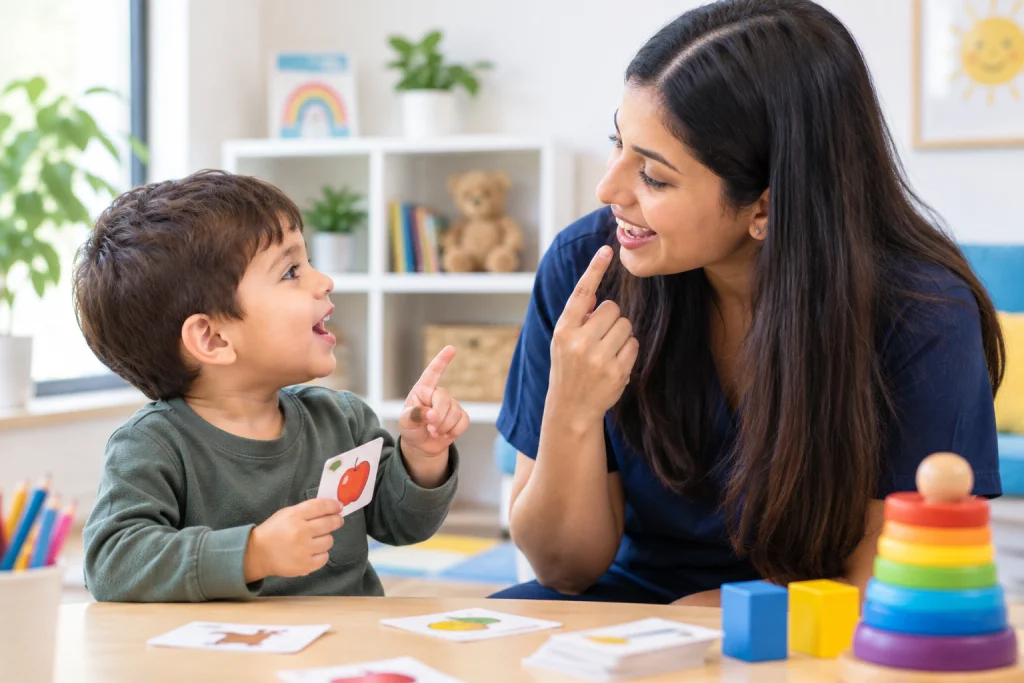
Between 18 months and 3 years, the two conditions look most alike from the outside, which is exactly why toddler-specific screening exists instead of relying on parent observation alone.
At a well-child visit around 18 to 24 months, most pediatricians run the M-CHAT-R/F, a short validated screening questionnaire built specifically to catch early autism indicators before a child is old enough for a formal comprehensive developmental evaluation.
A few toddler-specific patterns worth flagging to your pediatrician directly:
- No response to their name by 12 months, even with normal hearing
- No pointing or reaching to share interest by 15 to 18 months
- Loss of previously acquired words or gestures at any age (regression is always worth a same-week call, regardless of the reason)
- Persistent lining up of toys or objects rather than functional or pretend play by 24 months
It scores specific behaviors against a validated threshold instead of a gut feeling, which is the one thing a parent comparing symptoms at home can’t replicate. If your pediatrician hasn’t already run an M-CHAT-R/F and your child is between 18 and 30 months, it’s reasonable to ask for one at the next visit, and to book a speech evaluation in parallel rather than waiting for the pediatric visit to come around.
Why Do Speech Delay and Autism Get Confused?
Untangling speech delay vs autism gets hardest right here, at the point where a delay in talking is the most visible, most parent-noticesable symptom of both conditions, but it’s not the whole story for autism.
A few reasons the lines blur in real life:
- Autism doesn’t always present the same way. A child with strong verbal skills but rigid, one-sided conversation can look “talkative” while still meeting autism criteria.
- Speech delays can look social from a distance. A frustrated, silent toddler can appear withdrawn to an untrained eye, even when joint attention and social interest are completely typical.
- Age changes the picture. What’s a normal articulation error at 30 months? It can be a genuine flag at 4 years old.
- Bilingual households add noise. Kids learning two languages often hit spoken milestones a few months later, which makes an informal home assessment less reliable.
Most articles on this topic list signs side by side and stop there, without acknowledging that the two lists genuinely overlap in mild cases. That overlap is the actual reason a professional look, not another checklist, is the real next step.
Where Can I Find Speech Therapy Near Me?
If you’re searching for speech therapy near me at midnight, the useful next step is a same-week evaluation, not another week of comparing symptoms online.
A general rule we give families: if your child is 18 months with no words, 2 years with fewer than 25 words or no two-word phrases, or 3 years with speech that’s still hard for unfamiliar adults to understand, it’s worth a pediatric speech-language pathologist evaluation regardless of whether autism is even on your radar.
For families searching for speech therapy near me in the Twin Cities, our speech therapy services page outlines exactly what a first evaluation covers, how scheduling works, and what to expect at the first visit. Waiting for a delay to resolve on its own costs you the exact window, ages 2 to 5, when intervention has the most effect on long-term outcomes.
Getting a real answer to the speech delay vs autism question starts with a professional evaluation, not another night of comparing symptoms online.
Not sure where to start? Book a free 15-minute consultation and we’ll help you figure out the right first step, whether that’s speech therapy, a developmental screening, or both.
How Kids Care Approaches Both
Because the speech delay vs autism line isn’t always obvious in a two-year-old, we don’t hand a late-talking child a speech workbook and call it done. Every intake includes a look at the social and behavioral picture, so a delay doesn’t get treated as “just speech” when it’s actually part of something bigger.
Our process:
- Intake conversation covering communication milestones, family history, and daily routines, not just a word count.
- Direct play-based assessment of joint attention, gesture use, and social reciprocity alongside standard speech and articulation testing.
- A clear written outcome: either a focused, individualized treatment plan, a referral for a formal autism evaluation, or both running in parallel.
- A resource path for parents, including guidance through Minnesota’s Help Me Grow program (1-866-693-4769) and the state’s free early-childhood developmental referral system through MDE and MN’s Department of Children, Youth, and Families, for families who want a second, no-cost screening opinion before committing to a private evaluation.
In our experience, a meaningful share of the toddlers referred to us for “speech delay” show at least one autism-related flag once we screen for joint attention, gesture use, and play patterns, not because parents missed anything, but because those signals are genuinely subtle at age two. Treating the speech alone in those cases means the child makes slower progress, because the therapy target was too narrow.
If an evaluation does point toward an autism diagnosis, ABA therapy is often the recommended next step. For a closer look at what that actually involves day to day, our recent post on how ABA therapy can support your child’s development walks through the specific skills it targets and how families stay involved in the process.
What Do NIDCD and the CDC Say About Typical Milestones?
The National Institute on Deafness and Other Communication Disorders (NIDCD), part of the NIH, publishes age-by-age speech and language developmental milestones as a useful starting reference, though they’re explicitly not a diagnostic tool on their own. The CDC’s Learn the Signs. Act Early. program is a second reliable resource for age-by-age screening checklists. Both are useful starting points if you’re trying to map the speech delay vs autism question against your own child’s age before booking anything. For questions specific to how our team works with Minnesota families, our FAQs page covers the ones we hear most often.
Conclusion
At its core, speech delay vs autism comes down to two different questions. Speech delay asks, “How many words?” Autism asks, “How does this child connect, share attention, and use language socially?” Most late talkers are exactly that: late talkers, with every other communication system intact. A smaller number show additional signals worth a closer look, and the only reliable way to know which one you’re seeing is a real evaluation, not a longer checklist. Neither outcome is something to fear, and starting early makes the biggest difference either way.
Ready to Get Clarity? Here’s Your Next Step
If the speech delay vs. autism question is still unresolved for your family, you don’t need to figure it out on your own, and you don’t need to wait for certainty before reaching out. A single evaluation can tell you more than weeks of comparing symptoms online and put your family on the right path—whether that’s speech therapy, a developmental screening, or both.
Book your free 15-minute consultation with our team today and walk away with an actual answer, not another list of things to watch for.
Kids Care Inc.
📍 1400 Energy Park Dr Ste 18, Saint Paul, MN 55108
📞 651-441-6245
✉️ info@kidscareinc.com